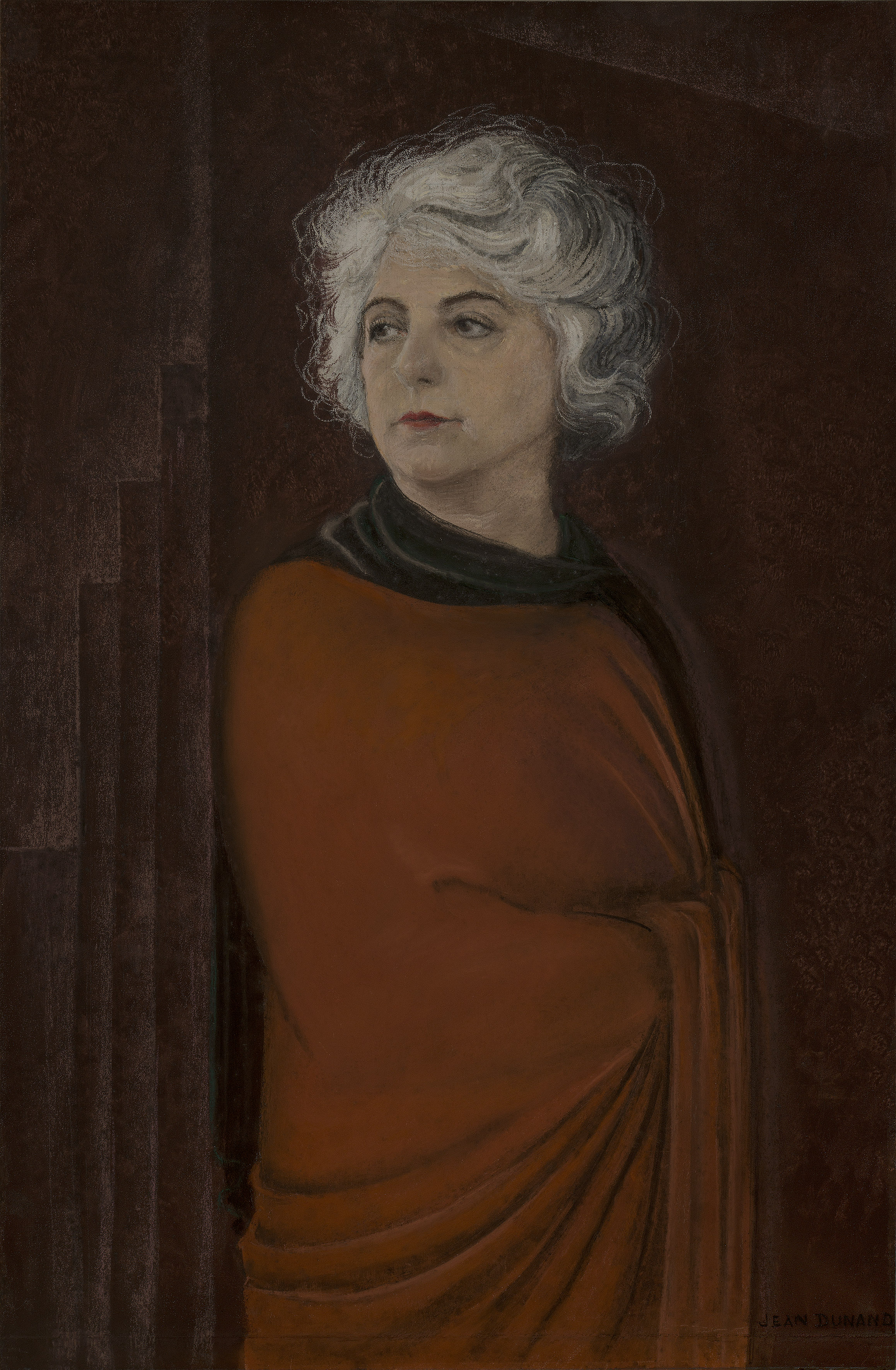
- 1876 (MDCCCLXXVI)
- 1975 (MCMLXXV)
- French
- Doucet, Callot Sœurs, Vionnet
- •The bias cut
- •The handkerchief dress
- •The cowl neckline
- •The halter dress
- •Worker welfare in her atelier
Madeleine Vionnet
The mathematician of cloth. The Burgundian seamstress who rotated the fabric forty-five degrees and discovered the body.
Madeleine Vionnet's great innovation was geometric. Fabric, she realised around 1919, could be cut on the diagonal rather than on the straight grain. The cloth behaved differently — it stretched, clung, draped against the body rather than over it. The garment was the silhouette. She called the technique la coupe en biais. It is the single most consequential cutting innovation in the history of twentieth-century womenswear.
She was born in 1876 in the Jura, apprenticed to a dressmaker at eleven, and arrived at the couture house Callot Sœurs in 1901. "Without them," she said later, "I would have continued to make Fords; they taught me to make Rolls-Royces."
The House
She opened her own house in 1912, and ran it — with breaks for the war and the Depression — until 1939. The atelier at 50 avenue Montaigne employed 1,200 workers at its height. She installed a dentist, a doctor, a dining hall, paid maternity leave, and a pension scheme. In 1930s Paris this was unheard of.
I have always tried to make the dress subservient to the woman, and not the woman to the dress. — Madeleine Vionnet
Geometry
Vionnet worked on a small wooden mannequin, eighty centimetres tall, draping toiles in miniature before committing to full scale. She had studied Isadora Duncan's dancing and the sculpture of the Hellenistic period; she understood garments as bodies in motion. Her bias-cut dresses of the 1920s and 1930s — the robe à mouchoirs, the cowl-backed evening gowns, the halter dresses that skimmed the spine without a zipper — dressed the actresses of early Hollywood and defined, in the general public mind, the shape of 1930s glamour.
Copyright
Vionnet was the first couturier to systematically photograph every model front, back, and side, and register the photograph as proof of authorship. The archive, now held at the Musée des Arts Décoratifs and the V&A, is the largest surviving record of any pre-war couture house. The copyright protection French courts now extend to fashion is substantially her legal legacy.
She closed her house in 1939, refusing to continue under German occupation, and lived in retirement until her death in 1975 at ninety-eight. Her cutting technique passed, through her assistants, into the training of Balenciaga, Comme des Garçons, and Azzedine Alaïa. The contemporary runway still turns to Vionnet when it wants to argue that a dress can be a mathematical object.
Related Dispatches

Elsa Schiaparelli and the Birth of Shocking Pink
Before the colour had a Pantone number, it had a bottle. The surrealist couturier who tinted the twentieth century.
Coco Chanel and the Liberation of the Modern Silhouette
She dressed the twentieth century in jersey, cropped its hair, and freed its waist. The story of how a milliner from Saumur became the architect of modern style.